What a tiny jug of milk told me about business
My dad and I have been going to the same greasy spoon café at home in Inverness-shire about once a month or so for years. It's no big deal, but we enjoy it - I mean, the bacon rolls are decent, the tea comes in a proper pot, and they let dogs in. This covers most of our essential requirements.
Until recently, nobody working there had treated an extra splash of milk with the tea as a possible threat to the future of the business either.
When we went last month, though, the café had a new owner. He also appeared to be the chef, and I noticed fairly quickly that he was bossing the poor waitress around like nobody's business. I didn't appreciate that very much, and, from the look of her, neither did she.
Anyway, I ordered my usual bacon roll and a pot of tea. Because I like quite a lot of milk in my tea, I asked for an extra wee jug of it.
Their milk jugs are ridiculously small. STUPIDLY small. Enough milk'll fit in one, perhaps, if you merely want to introduce the tea to the general idea of milk - so I've always needed two. At least! I've made this request for years without anybody having to consult senior management.
This time, though, the waitress - who'd worked there for years, incidentally - looked across the room at her new boss.
“I'll see if I can sneak you one,” she said, sounding a bit worried. “But I might have to charge you for it if he sees me.”
Well. That was NOT the customer experience I was used to from that business!
Small business customer experience sounds like the sort of subject that requires a strategy document, several coloured sticky notes, and possibly a consultant, but guess what, in practice, it can come down to how somebody answers a request for a thimbleful of milk.
The milk was really beside the point
I couldn't decide what bothered me more: the possibility of being charged for a few spoonfuls of milk, or the fact that she seemed frightened of being caught giving them to me.
Probably the latter, actually. The milk itself was kind of beside the point.
What I couldn't get out of my head was her quick glance across the room, the word “sneak”, and the feeling that both of us had been put in an awkward position over something worth pennies. I was no longer simply a customer asking for a very minor variation to an order, oh no! I'd apparently involved a member of staff in a low-level dairy smuggling operation!
The bacon roll was grand, same as usual. So was the tea. Yet that tiny wee interaction told me more about the new owner than anything he could have intentionally said about his café. I might have known nothing about his plans, his standards, or the sort of atmosphere he wanted to create, but I now knew that the waitress didn't feel trusted to make an extremely small decision for herself. By extension, I knew that asking for something slightly outside the standard arrangement might be made awkward.
That did not leave me with the usual warm and fuzzy feeling I'd walked out of that place for years with.
The moments nobody plans can be the most revealing
The likes of you and I put a great deal of care into the parts of our businesses we know people will see. We work on our websites, social media, photographs, wording, proposals, and the nice little automated emails telling clients exactly what happens next.
All of that matters. It helps somebody understand what we do, decide whether we are right for them, and know what to expect if they enquire.
But, but ... Customers don't experience a business only through the parts we deliberately arranged for them! They also form an impression through the moments nobody thought to pay quite as much attention to: how a small question is answered, whether an ordinary request makes them feel like a pest, or what happens when their circumstances don't fit neatly into the standard process.
When everything goes according to plan, a good system can carry the experience. The enquiry arrives, the correct email goes out, the meeting gets booked, and the client receives precisely what the process says they should receive. Nobody has to make an unusual decision.
It's when something falls just outside that process that the underlying judgement of the business becomes much easier to see.
Perhaps a client needs to move an appointment because her child is ill. Someone asks a question that isn't covered in the welcome guide. A customer wants a small alteration, an extra copy, or a little more time to decide. None of these automatically has to be granted, but the way the request is handled tells the person what it's like to deal with the business when life refuses to behave exactly as the workflow expected.
Good service doesn't mean saying yes to everything
There's an obvious complication here. For service businesses, boundaries absolutely matter.
Not every extra should be free, and a request that appears piddly and insignificant to a client can involve much more work than they realise. “Oh, can you just Photoshop that out?” is a particularly fine example. Depending on what that is, the answer may require three minutes, three hours, or access to industrial machinery and square eyes afterwards from gawping at tiny pixels on a big screen for too long.
Nor is it unreasonable for a café to charge for something that genuinely increases its costs. Businesses have to make money, gawd knows.. A collection of piddly little uncharged extras can eventually add up to a hefty expense, particularly when they're requested by several people every day rather than one woman with very peely-wally tea once a month.
So the question isn't whether every request should receive an automatic yes - obviously it's not that simple. It's whether the customer understands the answer and is treated reasonably while receiving it.
If something costs extra time or money, it's better to explain that before going ahead. A photographer can say that detailed retouching beyond what's included in the commission costs £X. A consultant can explain that the additional work falls outside the agreed scope and will require another half-day. A therapist can make the cancellation policy clear before anybody has to use it.
The client may not be delighted to pay more, but at least she knows where she stands. She hasn't been made to feel unreasonable for asking, and she can decide whether the additional work is worth the cost.
That's quite different from allowing a small request to become awkward because nobody has been trusted to answer it properly.
What happens when a request doesn't fit the process?
Processes are useful because they stop a business having to reinvent every decision. They help clients receive a consistent service and reduce the likelihood of important things being forgotten. I'm enormously fond of a good process myself. Left entirely unchecked, I would probably make a process for deciding whether another process was required.
But a process can't anticipate every human circumstance. There has to be some thought about what happens at the edges of it.
If somebody else works in the business, do they know which small decisions they can make without asking permission? If a client asks for something unusual, is there a straightforward way to explain what's possible? Has the business decided which rules genuinely protect its time, money, or ability to do good work, and which exist mostly because nobody has considered them recently?
For a solo business owner, the issue may be slightly different because there's no member of staff looking anxiously across the room. Even so, it's possible to make clients feel awkward without meaning to. A hurried reply, a defensive explanation, or a policy quoted without any acknowledgement of the situation can communicate far more than the words themselves.
Sometimes the answer still has to be no. The useful distinction is between protecting a sensible boundary and defending a rule for its own sake.
Small details help people understand the whole business
What stayed with me about the café wasn't the quality of the food. It was that tiny moment that shouted out something about how the place was being run.
Folks make these connections all the time. They notice whether a question is answered properly, whether the person dealing with them seems to be listening, and whether they feel looked after when something doesn't go quite as expected. One incident doesn't necessarily tell them everything about a business, of course, but it becomes part of the evidence they use to understand it.
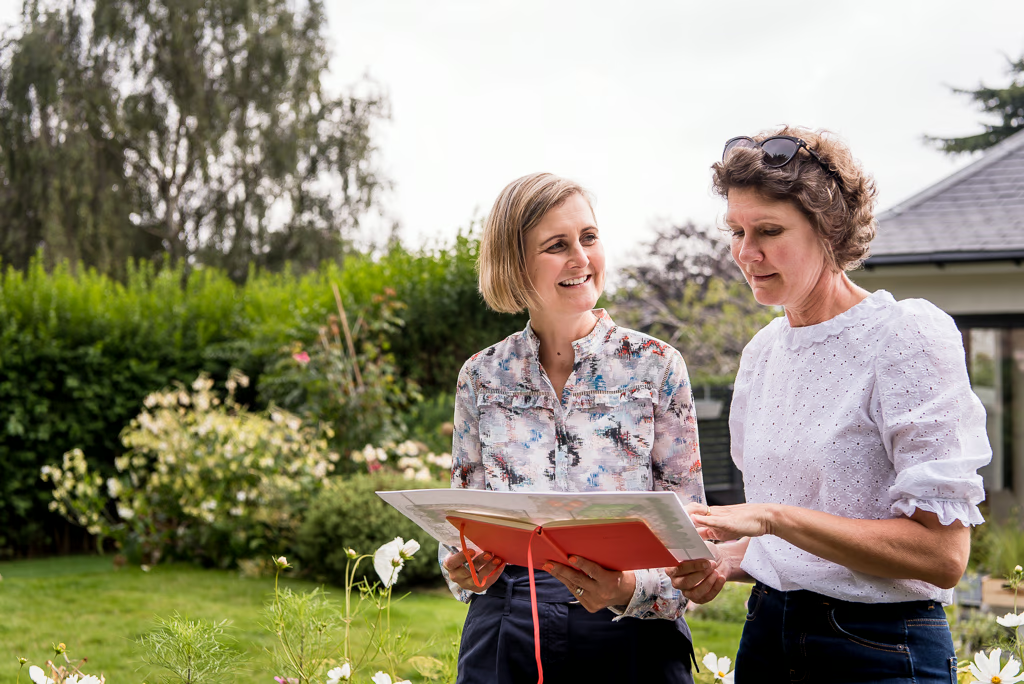
The same principle matters when you communicate your business visually. If the way you work with people is one of the reasons clients choose you, a gallery containing nothing but pleasant portraits won't show it. Someone can see what you look like, but not whether you listen carefully, explain things properly, or give a client your full attention.
This is why photographs of genuine or carefully recreated client interactions can be so useful. The detail might be your body language while somebody speaks, the materials you've prepared for them, or the way you guide them through a decision. It can't prove that every client will receive excellent service, any more than a polished website can, but it helps people picture what working with you might actually feel like.
It's part of the same thinking behind showing the work clients rarely see. The details that appear ordinary to you may be exactly what somebody else needs to see before they understand the care, judgement, and value within your service.
One small request is worth examining
Think of one wee request clients often make that doesn't fit perfectly into your usual process.
Do they know in advance if The Thing will cost extra? Have you found a way to answer without making them feel awkward for asking? If somebody else deals with the request, do they know what they are allowed to decide? Or is there a tiny, inexpensive bit of flexibility that would leave the client feeling properly looked after?
Oh I'll still go back to that greasy spoon with Dad next month. The bacon rolls are pretty decent, they let the dogs in, and hell but isn't habit a very powerful thing!
(Whether I'll have the balls to ask for a second jug of milk again is the big question.)
If the way you look after clients is an important part of why people choose you, your photographs should help them see that too. Find out how I plan brand photography around the things potential clients need to understand.