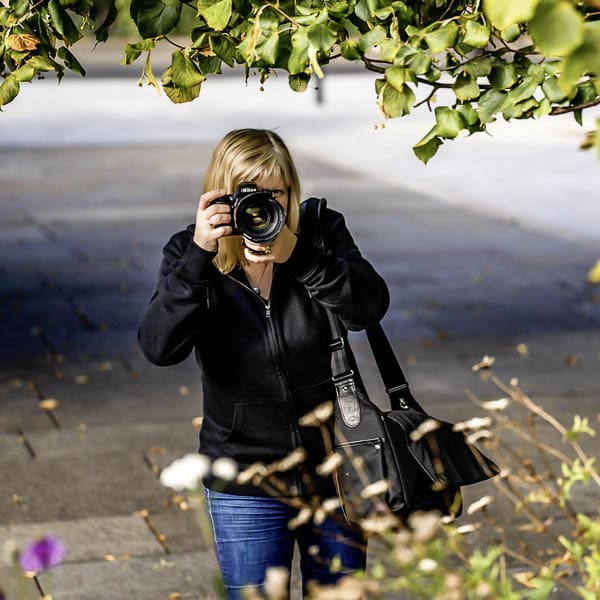
Although I’m using Edinburgh locations as examples here, the same principles apply wherever in the world you’re planning your brand photoshoot!
The best setting is one that helps communicate what your business does, how it feels to work with you, and what your prospective clients need to understand.
Brand photoshoot locations in Edinburgh
Everything was so white. My footsteps clacked on the gleaming tiles – would I scratch them? My head throbbed from the shards of noon sun piercing through the vast glass roof.
I tried not to look down at my shoes. The blinding light had picked up the splatter of mud on my left boot – a reminder of my morning dog walk through the woods. Wait, should I even have been wearing boots? Then I thought about my cat, who had demanded a hug before I left the house. It was spring. He was shedding.
As I almost ran to keep up with the haughty, stiffly-smiling woman leading me through the soulless office space, I felt completely out of place. The cold, sharp, modern architecture clashed with everything I loved.
And that’s the point.
Imagine if I had chosen to have a brand photoshoot there? If people saw my brand images set against that stark white, ultra-modern office complex, they’d assume I was corporate, formal, structured – someone I’m not. Oh HOW I am not ..! It would have sent completely the wrong message about me and my work.
That’s why finding the best photoshoot locations is vital. You’re not just picking something that looks good on camera. You’re choosing a setting that quietly communicates what sort of business you run, how you work with people, and what it feels like to be in your world. Getting your photography locations right is critical so it reflects your brand accurately and connects with your audience.
Getting it right just needs a bit of judgement and some common sense and local knowledge. One of the decisions that tends to trip people up early on is whether their shoot should be indoors, outdoors, or a mixture of both. That question makes much more sense once the foundations are in place, which is why it’s something I'll come back to later, in this article rather than starting with that.
1
Why location matters so much in brand photography
Your location does some of the explaining for you
Before anyone reads a single word on your website, your photos are already shaping an impression.
The setting you’re photographed in signals things like:
- how established your business feels
- whether your work is structured, creative, reflective, practical, or people-focused
- what kind of relationship a client can expect with you
This isn’t about being judged. It’s just about how humans make sense of visual information quickly. We all do it.
The right location helps your photos make sense
One of the things people rarely talk about is how much work bad photos create.
If your images don’t quite match your reality, you end up over-explaining yourself in your copy, attracting enquiries that aren’t a great fit, and feeling slightly uncomfortable using your own photos.
A well-chosen location removes that friction. It supports what you’re already saying, rather than asking your audience to do cognitive hard work to reconcile and interpret mixed signals.
This is also why location decisions connect closely to consistency. If your images feel coherent across your website, LinkedIn, and email marketing, everything becomes easier to reuse and maintain. (If you want practical examples of how to keep your visuals consistent across platforms, my post on visual consistency in social media photos is a good next read.)
It’s not about looking impressive
This is where people often go wrong.
They choose a location because it looks expensive, stylish, or aspirational, without stopping to ask whether it actually suits how they work. The result can be images that feel stiff, overly polished, or just a bit disconnected.
A thoughtful location does something much simpler. It helps you look like yourself on a good day and reflects your business accurately.
If you’re refreshing your visuals, this might help: Feeling ready for brand photography.
Location shapes how confident you feel on the day
There’s also a very practical side to this.
When you’re in a space that feels familiar or at least makes sense to you, it’s easier to settle into the shoot. You move more naturally. Your expressions soften. You don’t spend mental energy worrying about who’s watching or whether you’re “doing it right”.
That’s one of the reasons I don’t separate location planning from the rest of the shoot. It’s part of how we make the whole experience feel manageable rather than exposing.
If feeling awkward in front of the camera is already on your mind, you might find my article here useful:
How to feel more confident during your brand photo shoot.
Location is a strategic decision, not a decorative one
A brand shoot isn’t just about creating nice images for now. Most of my clients need photos that will work across their website, their social content, talks, features, and future projects.
That’s why location choice has to support flexibility and longevity.
This is exactly the thinking behind my shorter, planning-led sessions, where we prioritise images that earn their keep over time: Elevate brand photography sessions
And if you want a broader overview of how all of this fits together, this is a good place to start:
What brand photography actually does for your business.
Locations support clarity, credibility, and ease
Everything in this guide explains something I feel really strongly about: that location isn’t about finding somewhere fashionable, pretty, or popular.
It’s about choosing a setting that supports clarity, credibility, and ease, both for you and for the people trying to understand what you do.
2
The importance of local knowledge of Edinburgh
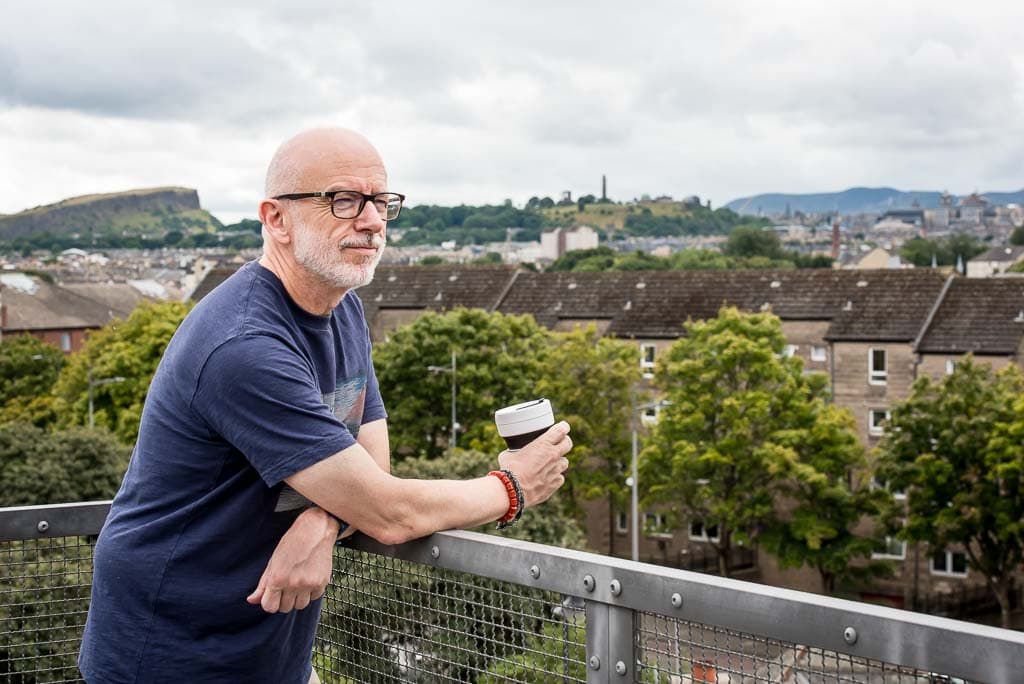
Edinburgh is a working city, not just a pretty backdrop
Edinburgh photographs beautifully, but that doesn’t mean every photogenic spot the tourists love works well for a brand shoot.
It’s a city people live and work in, with rhythms, pressure points, and patterns that don’t show up on Instagram. Light behaves differently street to street. Footfall changes dramatically depending on the day, the time, and what’s on. Some places that look empty online are shoulder-to-shoulder by mid-morning. Others feel surprisingly spacious if you know when to be there.
That context matters, because brand photography isn’t about capturing a moment. It’s about creating images you can rely on.
Knowing where not to go is as important as knowing where to go
Local knowledge isn’t just about favourites. It’s also about judgement.
There are locations that are:
- technically lovely but completely impractical
- consistently overcrowded
- harshly lit for most of the day
- awkward for pacing, movement, or privacy - or even safety
A shoot can unravel very quickly if you’re constantly stopping, waiting, dodging people, or trying to force a setting to work when it clearly doesn’t want to.
Because I’ve lived and worked here for decades, I know which areas reliably behave themselves and which ones are better avoided unless the timing is very specific. That means fewer compromises on the day and far less mental load for you.
Light behaves differently across the city
Edinburgh’s architecture does beautiful things with light, but it can also be unforgiving.
Tall stone buildings create deep shade. Narrow streets bounce light unpredictably. Open areas can feel exposed at certain times of day. Knowing how light moves through different parts of the city lets me plan locations that support you, rather than fighting against you.
This is especially important if you want images that feel consistent across your website and marketing. A location that looks great for ten minutes and then becomes unusable isn’t very helpful when we’re trying to build a flexible image set.
Experience changes the pace of the shoot
One of the quieter advantages of local knowledge is pace.
When locations are chosen with intention, we’re not rushing to beat crowds, constantly relocating, or second-guessing decisions mid-shoot. We can move through a small area and get variety without stress. That shows in the images.
People often say they felt more settled than they expected during their shoot. That’s rarely accidental. It’s the result of planning locations that behave predictably and give us space to work without interruption.
Familiarity creates better contingency plans
Edinburgh weather does what it likes, when it likes. That’s not a criticism, it’s just a fact.
Local familiarity means always having a Plan B that still makes sense visually. If one street becomes too busy or the light shifts faster than expected, I already know where we can pivot without losing the thread of the shoot.
That kind of flexibility is difficult to build if you’re relying on saved locations rather than lived experience.
Why this matters for your brand
All of this feeds back into the same principle: your photos should make your business easier to understand.
When location choices are grounded in lived knowledge of the city, the images feel considered rather than accidental. They hang together properly, they’re easier to reuse, and they don’t distract from what you actually want to say.
That’s why I don’t start by asking clients where they want to be photographed. The more useful starting point is understanding what their brand needs to communicate in the first place.
3
Starting with brand clarity
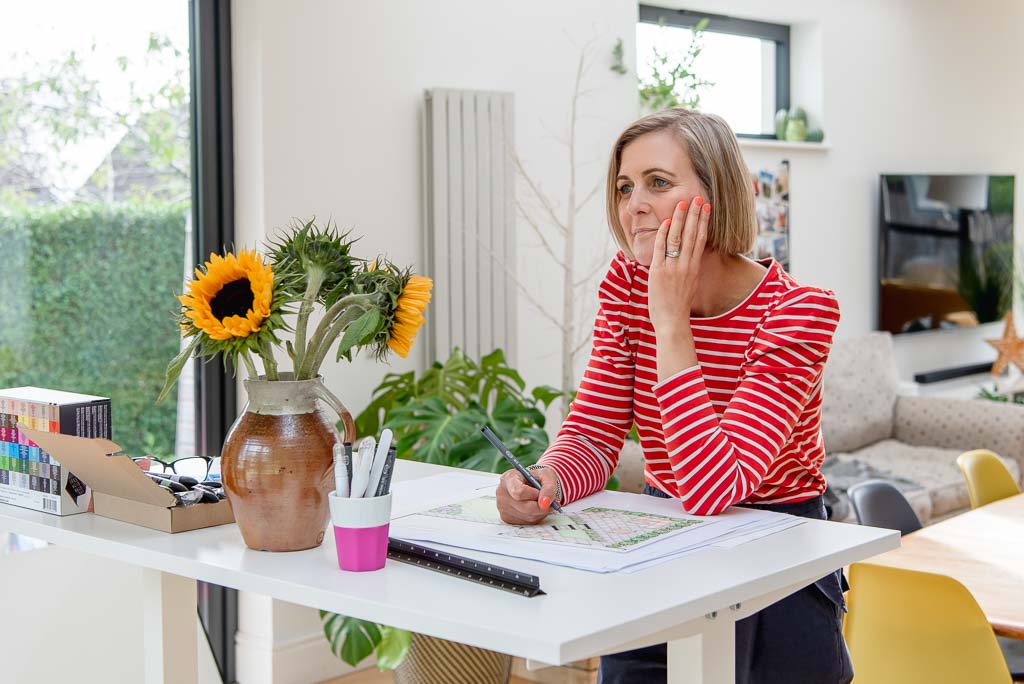
Why location isn’t the first decision
Most people assume a brand shoot starts with choosing a place. It doesn’t.
If you begin with location, you’re guessing. You’re trying to make a space do work it may not be suited for, and that’s when things start to feel awkward or overthought.
The more reliable starting point is clarity about your brand. Once that’s in place, location choices tend to narrow themselves quite quickly.
What we get clear on before we talk about places
Before we even think about streets, buildings, or interiors, we look at a few fundamentals.
We talk through what you actually do, who you’re speaking to, and what you need your images to support. That might be authority and trust, approachability and ease, or a sense of thoughtfulness and depth. Often it’s a combination, but there’s usually a clear emphasis once you say it out loud.
This isn’t about inventing a persona. It’s about articulating what’s already there, then making sure your visuals aren’t working against it.
If you’re specifically looking for personal brand photography in Edinburgh and across Scotland, I’ve written more about how I approach that here.
How you show up matters as much as where you are
A location can only support you if it suits how you naturally show up.
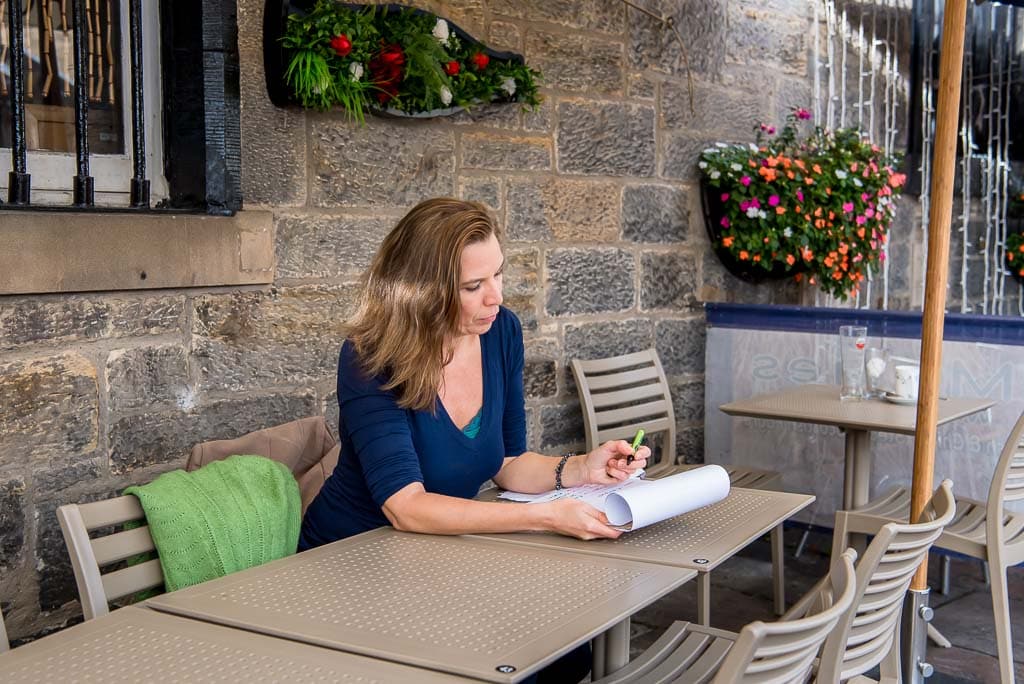
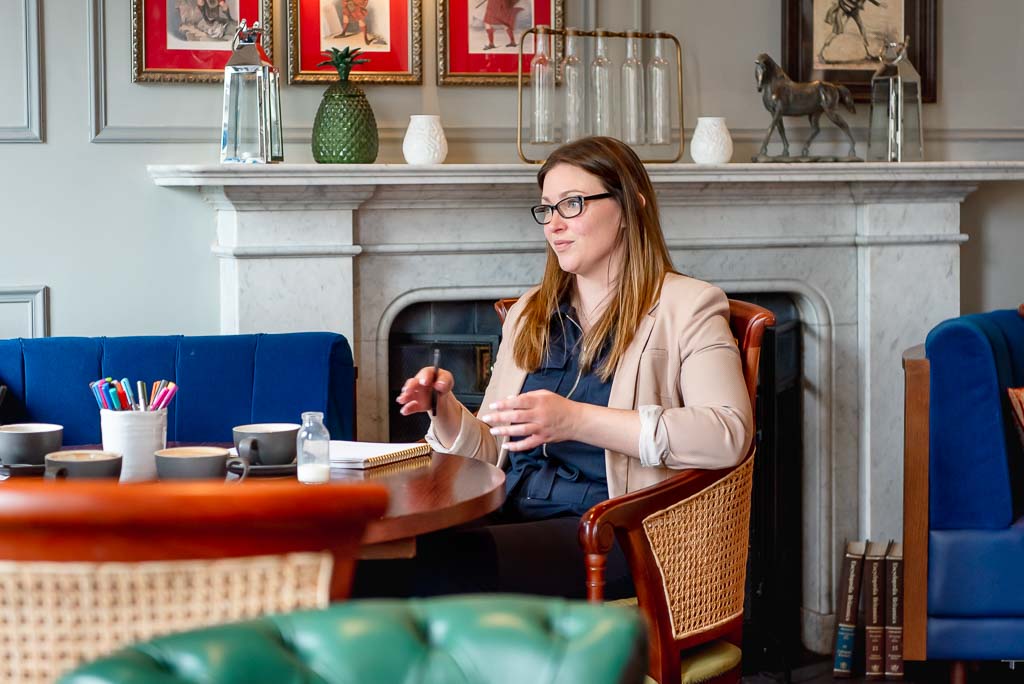
Some people are most themselves sitting at a table with a notebook or laptop, thinking things through. Others need movement. Some prefer contained spaces. Others need air and space around them. None of this is right or wrong, but it has a big impact on how natural you’ll look in the images.
When there’s a mismatch, it shows. You might not be able to put your finger on it, but the photos feel slightly strained. When there’s alignment, the images settle very quickly.
Clothes, surroundings, and coherence
Your clothing and your surroundings work together whether you plan for it or not.
If your wardrobe is soft, layered, and textural, a sharp, high-gloss setting can feel jarring. If your style is structured and minimal, a busy or visually cluttered background can dilute that clarity. The goal isn’t perfection. It’s coherence.
When those elements line up, your images feel easier to read. They don’t ask the viewer to reconcile conflicting signals.
Where you actually work, not where you think you should
This is an important one, and it’s where a lot of unnecessary pressure creeps in.
People often feel they should be photographed somewhere that looks more impressive than their real working environment. The trouble is, images based on aspiration rather than reality are harder to sustain. They can also attract the wrong expectations.
If you work from home, work remotely, or meet clients online, your photos don’t need to suggest something else entirely. They just need to support the way your business actually runs.
That doesn’t mean photographing you exactly where you sit every day. It means choosing settings that are believable and aligned, rather than exaggerated.
How you want people to feel
Brand photography isn’t just about what people see. It’s about what they take away.
Do you want people to feel reassured, engaged, challenged, supported, or invited into a conversation? Location plays a subtle but significant role in shaping that response.
Once that emotional tone is clear, it becomes much easier to rule locations in or out. Some places simply won’t support the feeling you’re aiming for, no matter how nice they look.
What changes once this is clear
When brand clarity comes first, location stops feeling like a gamble.
Decisions become more grounded. You’re no longer trying to choose between dozens of possibilities. You’re choosing between a small number of options that genuinely make sense for you and your work.
That’s the point at which location planning starts to feel straightforward rather than overwhelming, and it sets everything else up to fall into place more easily.
4
Indoor and outdoor location choices
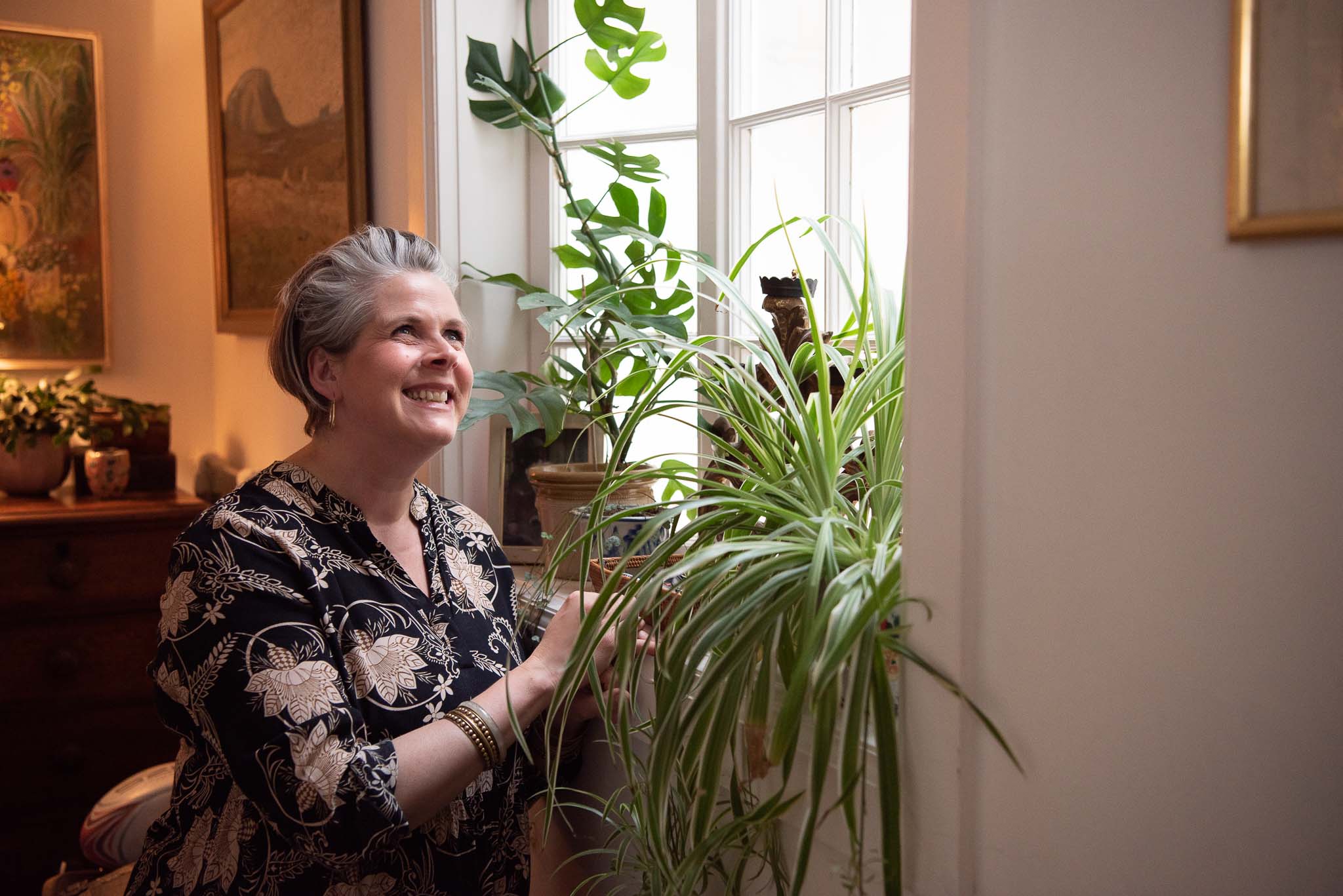
There isn’t a right answer, only the one that's right for you
One of the most common sticking points people have is whether their brand shoot should be indoors, outdoors, or a mixture of both. It can feel like a big decision, but it doesn’t need to be.
This isn’t about choosing the “best” option in general. It’s about choosing what supports your work, your energy, and how you want to be understood.
Once brand clarity is in place, this choice usually becomes much simpler.
When indoor locations tend to work best
Indoor locations often suit businesses that rely on focus, trust, and a bit more privacy and control.
If your work involves depth, conversation, or careful thinking, an interior space can help communicate that without distraction. It also suits people who want fewer variables on the day, especially when it comes to light, weather, and other people wandering through the background.
Indoor shoots are often a good fit if you spend most of your working life at a desk, in meetings, or in one-to-one sessions, or if you want your images to feel considered and composed rather than dynamic.
That said, indoor doesn’t mean corporate, and it doesn’t mean sterile. A well-chosen interior can still feel human, approachable, and full of character.
When outdoor locations make more sense
Outdoor locations often suit businesses that benefit from movement, space, or a sense of openness.
If you think best while walking, if your work has a strong lifestyle element, or if you want your images to feel more expansive, being outside can support that naturally. Outdoor settings also give you variation without needing to move far, which is very useful when we’re building a versatile image set.
The key is choosing outdoor locations that behave themselves. Busy tourist routes and highly exposed areas tend to work against you, whereas streets, paths, or green spaces with some breathing room give you far more flexibility.
Using both without overcomplicating things
Your choice here influences more than just the background.
It affects how much you move, how quickly we work, what you wear, and how much mental energy you need to spend on the day. A good decision makes the shoot feel straightforward. A poor one adds unnecessary effort.
That’s why I treat this as a planning decision, not a stylistic one. The goal is always the same: to choose settings that support you, rather than asking you to adapt to them.
Once this is decided, the rest of the planning becomes much easier.
How this decision affects the rest of the shoot
Your choice here influences more than just the background.
It affects how much you move, how quickly we work, what you wear, and how much mental energy you need to spend on the day. A good decision makes the shoot feel straightforward and contained. A poor one adds unnecessary effort.
That’s why I treat this as a planning decision, not a stylistic one. The goal is always the same: to choose settings that support you, rather than asking you to adapt to them.
5
My insider’s guide to some of Edinburgh’s best brand photo shoot locations
The locations that work best for brand photography aren’t always the obvious ones. They’re places I know will give us usable light, manageable footfall, and enough variety to create a coherent set of images without hopping from spot to spot.
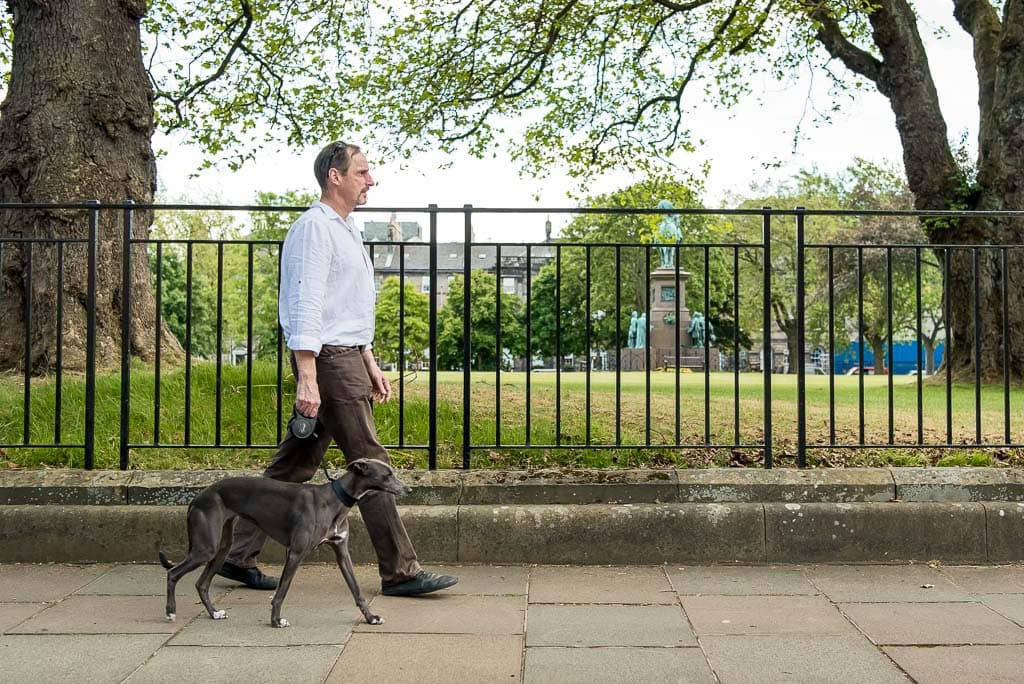
Many of my clients initially worry about choosing a location. “Where should I have my photos taken?” is a question I hear all the time. The short answer is - we decide together.
Below, I’ve outlined some of my favourite photo shoot locations in Edinburgh - from elegant urban settings to peaceful outdoor escapes. This will give you a sense of what’s possible, but remember: the final decision will be tailored to you and your brand.

City locations with a professional feel
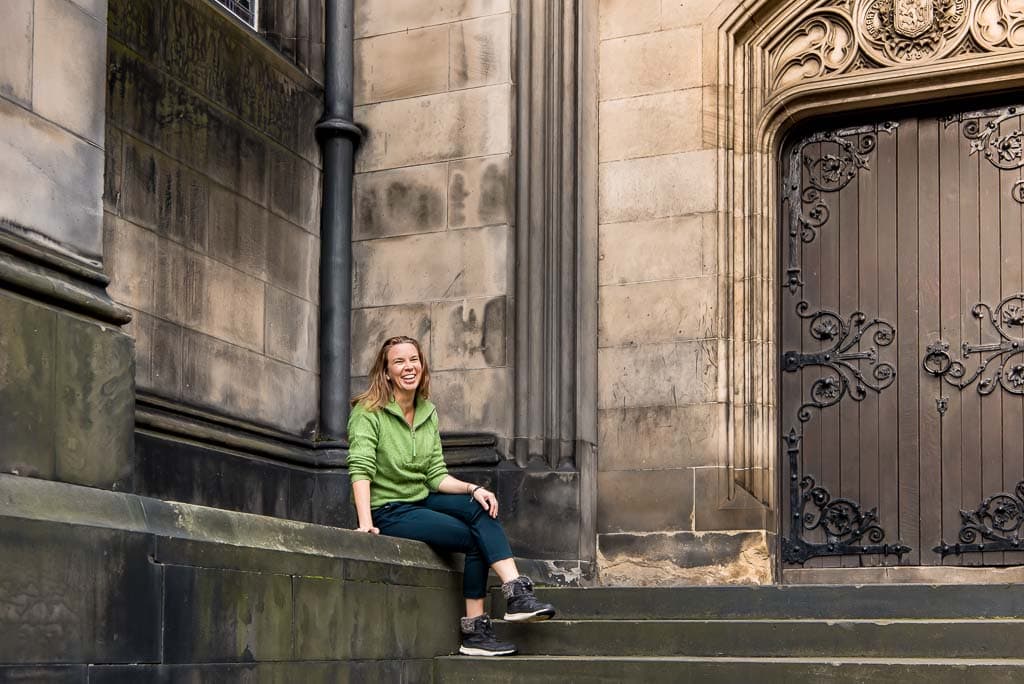
Edinburgh’s central areas offer a particular kind of visual shorthand. Stone buildings, clean lines, and consistent architecture tend to read as established, credible, and considered. These settings work well for businesses where trust, judgement, and experience matter.
Parts of the New Town and west end work well for this reason. The buildings feel substantial without being flashy, they have gravitas, and there’s enough visual restraint and uniformity that you don’t end up fighting the background for attention.
Here are some ideas:
1
Hidden mews back streets (quaint, quiet, stylish)
Edinburgh is full of tucked-away cobbled mews streets that feel both elegant and welcoming. These locations are less busy than main roads, offering a classic yet relaxed city aesthetic. The mix of stonework, colourful doors, and charming wee details makes them a favourite for brand shoots.
Perfect for:
- Coaches, therapists, creatives, boutique business owners.
Not so good for:
- Bold, high-energy brands that need a more dramatic setting.
2
The New Town and west end (elegant Georgian townhouses, boutique feel)
If you want a setting that feels sophisticated and refined, the west end is a fantastic choice. The Georgian buildings create a timeless, high-end feel, perfect for brands that want to position themselves as premium or luxury.
Perfect for:
- Business consultants, solicitors, lawyers, financial advisors, and other independent professionals
Not so good for:
- Brands that want a casual, relaxed, or nature-inspired look.
Creative and modern urban settings
Some brands need a bit more edge or movement in their images. For those, parts of the city with contemporary architecture, mixed textures, or a slightly industrial feel can work very well.
Leith is often a strong option here. It offers variety in a small area, from water and brickwork to murals and modern buildings, without needing to cover much ground. Certain parts of Quartermile and Edinburgh Park can also work, particularly for tech-adjacent businesses or people who want a more current, streamlined feel.
How about:
1
Leith waterfront (industrial meets artistic, urban vibrancy)
Leith has transformed into one of Edinburgh’s most creative districts, with a mix of industrial architecture, colourful murals, and waterside backdrops. If your brand is modern, creative, and energetic, this area offers a great mix of contemporary city vibes and artistic charm.
Perfect for:
- Social media managers, creatives, designers, digital marketers.
Not so good for:
- Traditional businesses that need a formal, structured setting.
I still can’t get my head around the fact that when I first moved to Edinburgh as a nervous 18 year old fresh from the Highlands, alone in the big city for the first time, Leith was a “no go” area.
A woman I worked with back in the day told me very firmly that “lassies don’t go to Leith, Niddrie, Granton, Pilton, Moredun, or Muirhouse on their own. Ever. And if you want to get stabbed, walk through the Meadows or down Lothian Road on your own at night.”
I'm glad times - and these places - have changed!
2
The Quartermile and Edinburgh Park (modern glass buildings, business-like aesthetic)
For brands that want a corporate yet stylish setting, these locations provide sleek glass architecture, wide open spaces, and a clean, professional look.
Perfect for:
- Tech entrepreneurs, business coaches, startup founders.
Not so good for:
- Personal brands that want warmth, personality, or a creative feel.
Natural and outdoor locations
If your brand is warm, approachable, or lifestyle-focused, outdoor locations can help capture that feeling. These spaces allow for movement, dynamic shots, and a sense of freedom, making them ideal for coaches, wellness practitioners, and creatives.
Green spaces that feel approachable
Greenery changes the tone of images very quickly. It tends to soften things, slow the pace, and make the setting feel more accessible.
Edinburgh has plenty of options here, but timing and positioning matter. Large parks can become very busy, while smaller gardens and edge-of-park locations often give you the same feel with far fewer interruptions.
Why not try these places?
1
Dean Village (historic, charming, and peaceful)
Dean Village is one of Edinburgh’s most picturesque spots. With its riverside setting, warm stone buildings, and quiet atmosphere, it’s perfect for brands that want a soft, storytelling-driven aesthetic. The time of the day and year is an important consideration though, as it can be really touristy.
Long ago I used to have pals who lived in Dean Village and man, was I envious. Until I got a car, got kids, etc ..! Even the very thought of trying to park in that place stresses me out. (NB: Don't drive there!)
Perfect for:
- Therapists, mindfulness coaches, creatives.
Not so good for:
- High-energy brands that need a bold and modern setting.
2
Portobello beach or Yellowcraigs beach (coastal, fresh, spacious feel)
For brands that want to convey freedom, creativity, or a connection to nature, the beach can be an effective setting. The open space, natural light, and relaxed vibe make it ideal for small businesses that want their images to feel light, airy, and full of energy.
Portobello can be a bit grotty in places - the sand is sometimes a bit manky with dead birds and litter, and the sea is usually a murky grey. When used selectively it can still be useful, but it’s rarely a whole-shoot solution. The big advantage is that it’s easy to get to.
Yellowcraigs is so much nicer and generally looks more coastal and less urban. There’s a lot of variety there in backdrops, from dunes and grass to shoreline and wide horizons, which is great - it's absolutely worth the drive. Cramond can also work if you time it so there aren't loads of dog walkers and others out and about.
But generally, beaches can be:
Perfect for:
- Wellness brands, fitness trainers, lifestyle brands.
Not so good for:
- Serious corporate brands that need a structured, business-like feel, or folks who don’t like a bit of breeze ruffling their hair
Choosing locations that give you useful variety
One of the most common mistakes I see is trying to cover too many places just for the sake of it.
Useful variety doesn’t come from constantly changing scenery and driving miles between different spots, it comes from choosing locations that offer multiple looks within a small area.
That might mean a street with different textures and a variety of colours, a garden with varied backdrops, or even just one interesting building with both interior and exterior options.
6
Practical considerations that affect the shoot
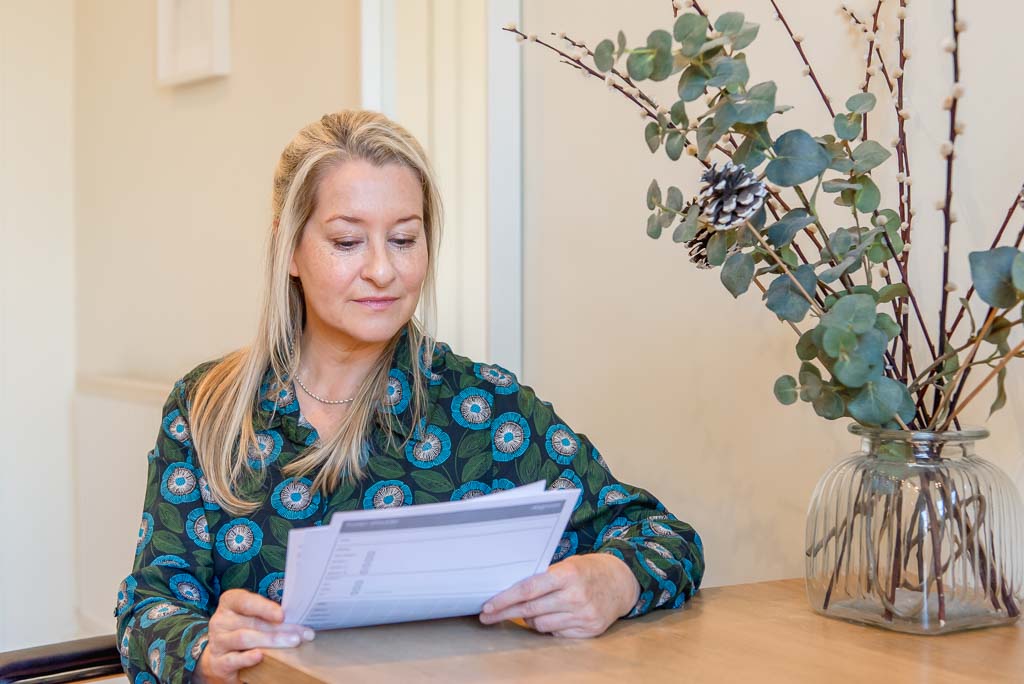
Light and timing
Light is one of the biggest factors in how your photos turn out, regardless of how good the location looks in real life.
Some places only work for a short window when the light is softer or more even. Others are in shade for most of the day, which can be useful if you want consistency and don’t want to squint or deal with harsh contrast. Narrow streets, tall stone buildings, and glass-heavy areas all behave differently depending on the time and season.
This is why I’m always thinking about when we’ll be in a location, not just where. A spot that looks perfect at 8.00 am can be completely unusable by late morning, and vice versa.
For example, a consultant I worked with had his heart set on a particular part of the Royal Mile he’d seen photographed beautifully online. We went there at the crack of dawn and got exactly the look he wanted - but later on, when the light changed and the street filled up, it was completely unusable.
It's worth remembering that "golden hour" (early morning or late afternoon) gives soft, flattering light that creates a warm, natural glow, and shaded areas or diffused light (midday on cloudy days) can help us avoid harsh shadows and squinting.
Direct midday sun on clear days - it creates harsh shadows, strong contrast, and unflattering highlights.
Privacy and comfort
Feeling at ease during your shoot matters more than most people realise.
If you’re constantly aware of people watching, walking through your shots, or hovering nearby, it’s much harder to relax. That tension shows up in posture, expression, and movement.
I look for locations that offer a bit of breathing room, whether that’s quieter streets, enclosed gardens, or semi-private interiors. Sometimes that means going a few metres off the obvious route rather than heading straight for the most recognisable spot.
Private spaces like rental properties, boutique studios, and co-working spaces can be ideal for quiet, controlled sessions where you can relax and take your time.
Brand colour compatibility
Your location doesn’t need to match your brand colours exactly, but it shouldn’t fight them.
Warm stone, greenery, and neutral interiors tend to work well for brands with softer palettes. Strong colours, murals, or industrial textures can suit bolder brands, but only if they’re chosen deliberately.
This is one of the reasons I always think about locations alongside your wardrobe. It’s much easier to get cohesive images when those decisions are made together, rather than in isolation.
For example, an interior designer with a muted, earthy toned palette needs locations with warm stone and neutral backdrops. A very white or glossy chrome and glass interior would looked jarring on her website next to her brand colours.
Matching your outfits to your location
This is where planning really pays off.
Outfits and locations are in constant conversation with each other. Structured clothing often suits simpler, more contained settings, and softer fabrics and layers tend to work better in outdoor or textural environments.
It’s not about dressing “up” or “down”, it’s about avoiding clashes that pull attention away from you
A social media manager I worked with planned a bright, patterned outfit but initially wanted to go to a very busy urban background but together, they felt chaotic and overwhelming. We decided on a simpler setting and her outfit suddenly made sense, rather than competing with her environment.
This is also why I think about how easy it’ll be for you to change outfits, adjust layers, or swap shoes without stress - when we move around different locations, being able to alter your look easily is very useful.
Accessibility, logistics, and outfit changes
Practicalities matter more than people expect.
I’m always thinking about where you can pause, change outfits, sit down briefly, or reset between shots. Nearby cafés, accessible toilets, benches, and short walking distances all make a difference to how the shoot feels.
A location that looks great but requires constant trekking or juggling bags can drain energy very quickly.
An author I photographed several outfit changes for different uses so we chose a location with a café nearby, which made changing, regrouping, and pacing the shoot much easier than trying to manage everything on the street.
Permissions and restrictions
While many locations in Edinburgh are free to use for brand photography, some historic or privately managed sites require permission or permits before you can shoot there. Historic Scotland and the National Trust for Scotland often require permits for photography on their properties. Well-known sites like Edinburgh Castle, Holyrood Park, and Craigmillar Castle often require permits too.
Other areas where you may need permission include:
- The Royal Botanic Garden Edinburgh – beautiful but requires prior approval and sometimes a location fee.
- Princes Street Gardens – managed by the council, and while informal photography is fine, commercial shoots may need permission.
- The University of Edinburgh campuses – some university buildings and courtyards have restrictions, especially the Old College.
- Waverley Station and train platforms – any kind of professional photography on railway property requires a permit from Network Rail.
- Private courtyards and exclusive venues – many hidden mews and high-end locations, such as The Signet Library or The Balmoral Hotel, require permission for professional photography.
This is something I check as part of planning, so there are no surprises on the day and no awkward interruptions mid-shoot.
The goal with all of this isn’t to overcomplicate things. It’s to remove the small stresses that add up and to make sure the location supports the shoot rather than becoming something you have to manage.
7
Location as part of your long-term visibility strategy
Thinking beyond a single shoot
It’s easy to think about location purely in terms of the shoot itself. Where you’ll be on the day, what it’ll look like, and whether it feels manageable.
But the real value of a brand shoot usually shows up later.
Most people aren’t booking photography just for one launch or one page on their website. They need images they can return to again and again, across different platforms and at different points in their business. That’s where location choice starts to matter in a quieter, longer-term way.
Choosing locations that support reuse
A location that’s very specific or visually dominant can be limiting.
It might look great in the moment, but if it only works in one context, you’ll quickly find yourself short on usable images. You might hesitate to reuse them because they feel too tied to a particular message, season, or version of your business.
Locations that are more adaptable tend to give you more mileage. They sit comfortably alongside different pieces of copy, work for different purposes, and don’t date as quickly. That doesn’t mean they’re bland. It means they leave room for you to evolve.
How location affects consistency across your marketing
Consistency doesn’t come from using the same photo everywhere. It comes from your images feeling like they belong to the same world.
When your locations are chosen with intention, your photos start to hang together naturally. Your website, LinkedIn profile, and email marketing feel visually aligned, even if the images themselves are different.
That consistency makes your business easier to recognise and easier to remember. It also reduces the pressure to constantly create something new just to keep things looking coherent.
Making future updates easier
One of the less obvious benefits of thoughtful location planning is how it supports future shoots.
When your initial images are grounded in locations that genuinely suit you, it’s much easier to build on them later. You’re not trying to pivot away from something that never quite fitted in the first place. You’re adding to a visual language that already makes sense.
That’s particularly helpful if you update your photos in stages rather than all at once.
Why this matters beyond aesthetics
Location choice isn’t about taste or trends. It’s about making sure your visibility supports your business rather than adding extra work.
Images that feel coherent, flexible, and aligned are easier to use. They reduce the need to explain yourself. They help people understand what you do more quickly, and they continue to do that quietly in the background long after the shoot is over.
That’s why I treat location as part of the bigger picture, not a styling decision to be made at the last minute.
Oh, and that job I went for that I told you about at the beginning ... I didn't get it.
Instead, I ended up working in a building that was over 250 years old, right in the centre of Edinburgh. Thick stone walls, tall windows, staircases worn by the feet of many people long gone. Fireplaces, now unused, that would have kept the chill off them in winter.
What I loved about it was the history. I was constantly aware that others had sat at desks in those rooms, thought their way through problems, and made decisions that mattered. Walking into work every day, I felt a strong connection to those people and a real sense of belonging in being part of that continuity.
The building wasn't fancy and impressive in a flash the cash kind of way - it didn’t need to. Its age, purpose, and permanence were obvious, and that suited me. I wasn’t distracted by the space or trying to adjust myself to fit it. I was happy in it and could focus on the job in front of me.
That experience shaped how I think about brand photography.
When a location genuinely fits, it supports you without drawing attention to itself. You don’t have to be someone you're not or work around it. It reinforces what you’re already doing, rather than pulling focus away.
That’s what I want for my clients: not a setting chosen because it looks fashionable or aspirational, but a place that makes sense for who you are, how you work, and what you want people to understand when they come across your business.
Choosing the right location isn’t about decoration, it's fit, and when you've got that right, your business photos become easier to use, easier to trust, and far more effective over time.
I've summarised this in a LinkedIn article here - if you're on that platform, I'd love you to comment on it with your thoughts!