Last week, my dad and I made the ten-hour drive from Scotland to Hampshire for my uncle’s funeral.
It was a terribly sad reason for the journey as my uncle was such a great guy whom I liked immensely. But, Dad is one of the BEST travelling companions I could have! We can spend hours discussing the finer points of English, Gaelic, and Welsh language, different types of trees, obscure dog breeds, investigating the origins of place names we’ve spotted on road signs, and disappearing down Google rabbit holes that would make most other passengers feign sleep somewhere around Penrith.
He was on Google! I was driving. I feel this distinction is important.
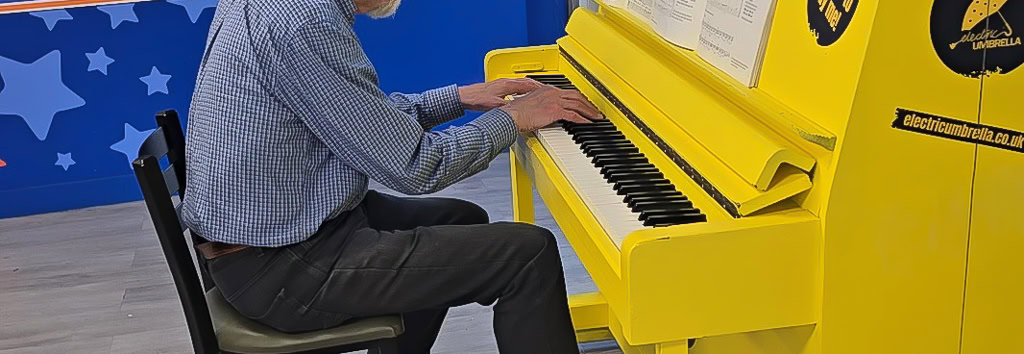
At one motorway service station, somewhere in the bowels of England, we stopped for a cup of tea. A wifie had been playing a public piano to raise money for charity, and she finished just as we were getting ready to leave.
Dad stopped abruptly, looked at the piano, then sat down and launched into an energetic version of St Louis Blues.
My dad is 83.
He hammered it out extremely well, then simply got up and walked away again, as though public pianos were dotted around England specifically so passing octogenarian Welshmen could give them a quick blast.
It lasted only a few minutes, but it’s probably the detail from our twenty hours on the road that helps you picture him best.
A list of facts isn’t the same as knowing someone
If I told you that Dad is 83, Welsh, and a retired English teacher, you’d have several perfectly accurate facts about him. They’d tell you something about his age, his background, and the work he did for most of his life.
You still wouldn’t know that he might commandeer a piano in a motorway service station without warning, though!
That tiny wee incident reveals his humour, his love of music (and skill at performing it!), his confidence, and his willingness to have a go at something simply because the opportunity presented itself. It helps you imagine what spending time with him might actually be like in a way that his former job title never could.
And boy, there are huge differences between those two kinds of information!
Good quality photographs can still say very little
Business photographs often do the visual equivalent of giving people a neat list of facts.
A perfectly respectable headshot might say: this is what I look like; this is roughly what I do; I own a jacket; and I’ve stood in a pretty location.
None of that is wrong - a clear, professional photograph is useful, and there are plenty of situations where a straightforward headshot is exactly what’s needed.
But for a service-based business, potential clients are rarely considering your professional credentials alone. They’re also trying to work out what sort of person you are, and they want some sense of what it might feel like to talk to you, trust you with a problem, or spend time working with you.
This is where accurate photographs can become kind of interchangeable. Swap the face, the laptop, and the coffee cup, and the photograph could belong to almost anyone in the same profession. It identifies the person without helping us understand very much about them.
Good personal brand photography has a much larger communication job - it still needs to show you looking credible and approachable, but it can also reveal some of the specific details that make your way of working recognisably yours.
The detail doesn’t need to be dramatic
Fortunately, nobody needs to develop an unexpected jazz piano career purely for the benefit of their website, ha!
The useful detail for you might be that your dog that attends every client call, the battered notebook you cover in diagrams, or the walking route where you untangle difficult problems. It might be the material you always bring to a workshop, the collection that has influenced your work, or the corner of your studio where ideas first take shape. Or the soft light in your consulting rooms.
I’ve written before about why the dog absolutely needs to be in the photographs. The point wasn’t that every business owner should arrive at a photoshoot accompanied by an animal, but rather that we often remove the interesting, relevant parts of our lives from our business photographs before anybody has suggested they don’t belong there.
The answer isn’t to cram every hobby, pet, treasured possession, and personal eccentricity into one photoshoot. A photograph of you playing the euphonium while icing a cake and being supervised by three spaniels may be extremely memorable, but it won’t necessarily help somebody understand your accountancy practice, will it!
The detail earns its place when it reveals something useful. It might show how you think, how you make people feel, what shapes your judgement, or the kind of experience a client can expect when working with you.
What would make the photograph unmistakably yours?
Have a look at the photographs currently representing your business and try a slightly odd thought experiment.
If your face were removed and replaced with another perfectly competent person's, would the images still communicate something recognisably yours?
Perhaps they would. The places, objects, interactions, and small working details might combine to give somebody a strong sense of you and your business.
If they wouldn’t, that doesn’t mean the photographs are bad. It may simply mean they’re doing the identification job without doing much of the understanding job.
Make a note of one thing you wish they revealed. Not an impressive fact to bolt on, but a detail that would help the right client picture you more accurately. What do people tend to notice after they’ve spent time with you? What makes your approach different in practice? What belongs naturally in your working life but has never appeared in your photographs? What makes you YOU? Do your business photos show it? Any of it?
Those questions are far more useful at the beginning of a photoshoot than deciding whether you should hold a mug, stare at a laptop, or stand in a pretty street that everyone else gets their photos taken in too.
Dad’s unscheduled recital didn’t give anyone at that service station his formal biography, but anyone who saw it understood something about him that a perfectly accurate description would have missed.
I think for our next long drive, I’ll be checking service stations for pianos before agreeing to the stopping arrangements.