How to show your expertise in brand photographs is something lots of clients ask me about.
I’ve been reviewing some older client photographs recently, which is always slightly dangerous. A photographer can open one folder with the firm intention of checking a single image and emerge considerably later having investigated six unrelated shoots and wondered what became of a jumper she used to own.
One of the sets came from a headshot session with Patrick, who was tutoring university-level physics at the time.
My own scientific career came to an undistinguished end when I failed O Grade Chemistry. Maths was never exactly a source of national pride either, so I hadn’t a hope in hell of understanding a single thing Patrick had written on his blackboard.
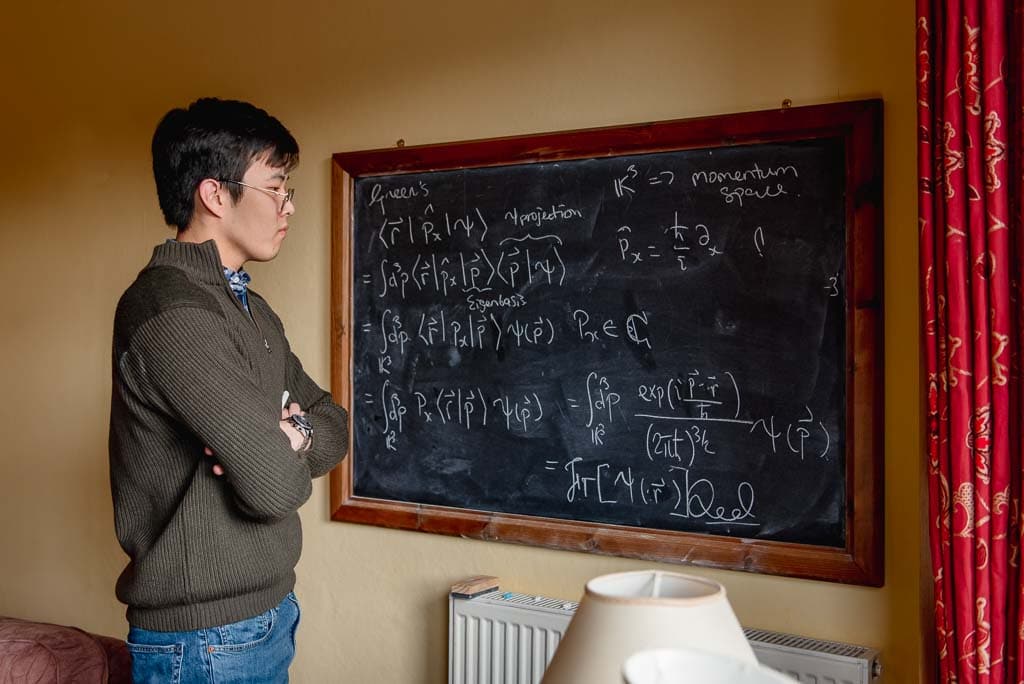
I didn’t need to understand it, though. I could see immediately that the board made the photograph more useful.
It told me that Patrick worked in physics, certainly, but it did more than identify the general subject. The amount and complexity of the material suggested the level at which he worked, while his expression showed somebody absorbed in a difficult problem rather than overwhelmed by it. For a university student looking for help, those distinctions would matter.
Expertise is often the part nobody can see
This is a common problem for service businesses. A client sees the consultation, the advice, or the finished result, but much of the value behind it remains hidden. They don’t necessarily see the years of experience, the analysis, the decisions that were considered and discarded, or the judgement that allowed the right answer to emerge.
A standard portrait can show what you look like and help people recognise you. It may also suggest warmth, professionalism, or approachability. What it usually can’t do on its own is explain what you know, how you think, or the level at which you work.
That’s one reason independent professionals often need more than a headshot. The problem isn’t that the headshot has failed. It’s simply being asked to communicate information that doesn’t exist within the frame.
If you want to show your expertise in brand photographs, something visible has to provide the evidence.
The blackboard wasn’t a happy accident
Patrick’s session had been booked for headshots, but we deliberately made some wider photographs showing parts of his work and life as well. The blackboard wasn’t something I happened to notice after I arrived and hurriedly placed him beside it.
We included it because it could tell prospective students something a plain portrait couldn’t. Patrick filled it with genuine material from his work, rather than a few hastily added equations intended to suggest that Something Scientific Is Happening.
I couldn’t tell whether those equations were advanced, elementary, or a recipe for soup. His prospective students were in a much better position to recognise them, and they were the people the photograph needed to reach.
That same question now sits at the centre of how I plan personal brand photography in Edinburgh. Before I start deciding on locations, clothing, activities, or objects, I work out what the right clients need to understand and what we could place in the frame to help them recognise it.

Patrick’s blackboard helps to show his expertise in advanced university physics before a prospective student has read a word about his tuition.
The detail has to be specific enough to mean something
Complexity alone doesn’t prove expertise. A blackboard covered in impressive-looking symbols could still be meaningless, just as a desk covered in paperwork doesn’t automatically tell us that the person sitting behind it is exceptionally capable.
What gives the detail value is its genuine connection to the work. To me, Patrick’s board says “advanced physics”. To a prospective student, it may say far more: the particular field, the expected level of knowledge, or the sort of problem they need help understanding. The right audience can read information in a specialist detail that everybody else will miss.
That’s perfectly all right. A photograph doesn’t have to explain your entire profession to every person who sees it. It needs to help the right person recognise something relevant.
For a consultant, that evidence might be an annotated report showing how she examines a problem. A therapist might use materials from a particular method of working, while a designer could show the drafts, measurements, or decisions behind the finished design. I’ve written before about how photographs can show the knowledge, preparation, and judgement behind a finished result, rather than leaving clients to assume that the result appeared by magic.
The detail must still earn its place. A notebook, coffee cup, or laptop might be part of your working day, but that doesn’t necessarily make it informative. Unless there’s something specific about the activity or what’s visible on the screen, a laptop tells us chiefly that you own a laptop, which narrows the field to approximately everybody.
Showing expertise doesn’t have to make you look intimidating
The ordinary room contributes something important to Patrick’s photograph too. Advanced physics can sound rather formidable, particularly to those of us who still become uneasy when letters start appearing in sums. The setting prevents the image from feeling remote or overly academic, while Patrick’s body language suggests concentration without making him appear unapproachable.
That balance matters for many service businesses. Potential clients may need evidence that you understand a complicated subject, but they also need to imagine being able to ask you questions without feeling foolish. A photograph can show that the work requires serious knowledge while still allowing the person behind it to seem accessible.
This isn’t achieved by adding an approachable expression after everything else has been decided. The setting, activity, expression, and chosen detail work together. Remove the blackboard and we lose much of the expertise. Remove Patrick and we’re left with equations but no sense of the person who can help somebody understand them.
Different details can do different jobs
Not every photograph in a useful collection has to prove your professional knowledge. People may also want to understand something about your personality, interests, or life beyond the work. The important thing is knowing that those photographs have a different job.
Patrick also played the accordion, so we photographed that part of his life. The accordion doesn’t tell us whether he can explain advanced physics, just as the blackboard doesn’t tell us what he enjoys doing when he isn’t teaching. Together, the photographs give us a more rounded sense of him without asking one image to communicate absolutely everything.

Patrick’s accordion introduces a personal interest, giving this photograph a different job from the images showing his university physics work.
Trying to make every photograph say “expert, approachable, experienced, interesting, professional, creative, friendly, and fond of a decent cup of tea” generally produces a muddle. A collection works better when the individual photographs divide the work between them.
What could make your own expertise visible?
Start with the message rather than the object. This is why planning a brand photoshoot needs to begin with what the photographs must communicate, rather than a list of attractive locations or things you could hold. Try completing this sentence:
This photograph needs to help the right client recognise that I…
The answer might be that you deal with unusually complicated cases, examine problems in great detail, use a method your clients value, or bring a particular depth of experience to your work. Once you know what needs to be recognised, think about what somebody would see if they watched you doing that work in real life.
It might be a document, a framework, a specialist tool, part of your working environment, or an action you take regularly. It may not look impressive to everybody, and it doesn’t need to. The question is whether it carries useful meaning for the people who are already looking for somebody like you.
If you’d rather work through that planning with me, my Soar brand photography commission is designed for service-based business owners who need a varied collection showing both their expertise and the person behind it. We decide what potential clients need to recognise first, then plan the activities, settings, and details that can make those things visible.
I still couldn’t tell you what any of Patrick’s equations mean, and they make me feel slightly queasy if I look at them for too long. Fortunately, understanding physics wasn’t required. The useful part was recognising that the blackboard could help the right people understand something important about Patrick’s work before he’d said a word.
Which is just as well, because if we’d waited for me to understand the equations first, Patrick might still be standing beside that blackboard!