Choosing a therapist is an unusually personal decision, don't you think?
Qualifications and areas of expertise matter, of course, but prospective clients are also looking for something that’s much harder to put into words. Trust is EVERYTHING.
They want some sense of the person they’ll be talking to. Will they feel safe? Will they be understood? Will this person be able to cope with the things they’re afraid to say out loud?
When Jordan Herselman contacted me about creating new photographs for Lion Heart Coaching & Counseling, she didn’t simply need an updated headshot. She needed a collection that could begin answering those questions.
Jordan’s a trauma therapist who combines Brainspotting, Internal Family Systems-informed parts work, and Reiki with a strong understanding of the relationship between the brain and body. She works online with therapy clients throughout Colorado and provides coaching more widely.
Her approach was unlike anything I’d encountered before. I’d heard of Reiki, but Brainspotting and the way Jordan combines brain-, body- and parts-based work were entirely new to me. I found it fascinating - I always learn so much from my clients!
The photography challenge was to communicate enough of that distinctive approach to make people curious enough to want to contact her, while also showing the warmth, humour, and strength of the person they’d actually meet.

Indoor portraits added another setting to Jordan’s Edinburgh therapist brand photography collection while retaining the warmth and informality she wanted.
Photographing a service built on trust
Jordan helps people experiencing trauma, addiction, anxiety, depression, relationship difficulties, and chronic pain. Many of her ideal clients have already tried more conventional forms of therapy and feel they need something different.
The most important thing for me wasn’t to make Jordan appear polished in a general professional sense. Her photographs needed to suggest that she’d be able to stay present when a client brought something difficult into the room.
During our planning, Jordan described the feeling she wanted prospective clients to have:
“Oh, she’s got this. She can handle me. She gives me hope that healing is possible.”
That gave us a far more useful starting point than simply aiming for friendly or professional photographs.
Jordan described the qualities she wanted the finished collection to convey as safe, distinctive, playful, fierce and hopeful. The word “fierce” was particularly important. She didn’t mean intimidating or aggressive. She meant fierce compassion: the tenacity to stay with someone through difficult work rather than encouraging them to avoid or suppress what they’re feeling.
We therefore needed direct eye contact and expressions that felt strong and steady, but we also needed genuine laughter, movement and warmth. Showing only one side of who she is would’ve created a misleading impression of what it’s like to work with her.

Direct eye contact helped us communicate the strength and reassurance Jordan wanted prospective clients to recognise in her.
Making an unfamiliar therapeutic approach visible
Therapy isn’t particularly easy to photograph.
Much of the meaningful work happens through listening, observation, and conversation, so without careful planning, a photography session for a therapist can easily produce little more than a series of pleasant portraits in a consulting room.
That wouldn’t have been enough for Jordan because the way she works is a substantial part of what distinguishes Lion Heart Coaching & Counseling.
Brainspotting uses a pointer to help identify positions in a person’s visual field that may be connected with emotional or physical experiences. Jordan had an orange pointer that she uses in her work, so we included it in several photographs.
We didn’t need every viewer to understand the method immediately - the pointer’s job was to create curiosity and give Jordan a recognisable image she could use when explaining Brainspotting on her website or in her content.
We also photographed Jordan writing in a notebook. This helped us represent the learning, reflection and curiosity behind her work without resorting to generic laptop photographs that wouldn’t have told us anything specific about her.

Jordan’s Brainspotting pointer connected the photography directly with a distinctive part of her therapeutic work.

Working details gave Jordan images she could use when discussing learning, reflection, and the thinking behind her therapeutic approach.
Jordan hadn’t been entirely convinced about including the pointer, but I thought it mattered enough to insist that we photograph it anyway. It was specific to the way she worked, which made it far more useful than another general portrait. Once she saw the finished collection, she wrote:
“I am also SO grateful you were so intentional about the pointer image during the shoot. It ended up being one of my favorites.”
That’s one of the reasons detailed planning matters. The photographs that initially feel the least obvious can turn out to be particularly valuable because they show something your potential clients won’t see in everybody else’s image library.
This is why independent professionals generally need more than a headshot. A headshot can show what you look like, but it can’t explain very much about how you think, how you work or why somebody might choose you.
Why Edinburgh suited Jordan
Jordan’s from Denver, Colorado, and spending time outdoors is an important part of her life. Although she works online and her clients don’t need to be based in Scotland, she wanted the photographs to feel like her.
She hadn’t visited Edinburgh before, but it offered the combination we needed: a recognisable city, beautiful architecture, weathered stone, riverside paths, and a surprising amount of greenery.
We deliberately avoided making every photograph unmistakably Edinburgh. A few images needed a clear sense of place, but we definitely didn't want the whole collection to look like tourism photography! Jordan needed to be able to use the photographs after she’d moved on, without every website visitor wondering whether Lion Heart had suddenly relocated to Scotland.
We combined indoor portraits with quieter corners around St John’s Episcopal Church, Dean Village, and the Water of Leith. Those locations gave us colour, stonework, foliage, water and city texture within a relatively compact part of Edinburgh.
I loved spending the day with somebody who values being outdoors as much as I do. Exploring on foot felt entirely appropriate for Jordan, rather than something we’d imposed on the shoot simply because Edinburgh happens to be photogenic.

Edinburgh’s greener corners reflected Jordan’s love of being outdoors and gave the collection a softer alternative to the city’s stone architecture.
Planning carefully, but leaving room for discovery
Our shoot plan set out the practical details: what Jordan needed the photographs to communicate, how they’d be used, which clothes would suit each location and what range of expressions and compositions we needed.
It didn’t dictate every frame.
A detailed plan should give a shoot direction, but it also needs to leave room for the location, light, and person in front of the camera to contribute something unexpected. Otherwise, you can become so determined to reproduce a document that you miss what’s actually happening around you!
That balance was particularly useful during Jordan’s shoot. We knew we wanted photographs that showed her relationship with the outdoors, but we didn’t know quite what form they’d take until we started exploring.
Then we found the waterfall. Ohhhhh, the waterfall!

Careful planning gave the shoot direction, but left us free to make use of the waterfall we discovered in the Water of Leith.
The waterfall Edinburgh had been hiding from me
I’ve lived and worked around Edinburgh for decades, yet I hadn’t known there was a small waterfall tucked away in the middle of the city. I was insanely excited when we found it!
What surprised me even more was Jordan’s reaction. There wasn’t a lengthy discussion about whether she’d be willing to get her feet wet - nope, she simply hopped straight down into the water without a second thought.
That’s precisely the sort of thing I’m prone to doing myself, but I’m not accustomed to clients beating me to it!
The waterfall gave us something we couldn’t have planned in quite the same way: movement, a sense of exploration, and photographs that reflected Jordan’s willingness to go towards an experience rather than remain safely at a distance.
They also felt connected to her Explorer brand archetype and her belief in the relationship between emotional and physical experience. We didn’t need to explain any of that literally in the photographs. The setting, movement and expression did the work.

Jordan hopped straight into the water without a second thought, giving us photographs that reflected her adventurousness and love of the outdoors.
Jordan later described the shoot as “such a fun adventure” in her Google review:
“We explored the city, crossed a river, dodged hanging laundry, and had some laughs to get the perfect photos.”
That’s a rather accurate summary of the day, I reckon!
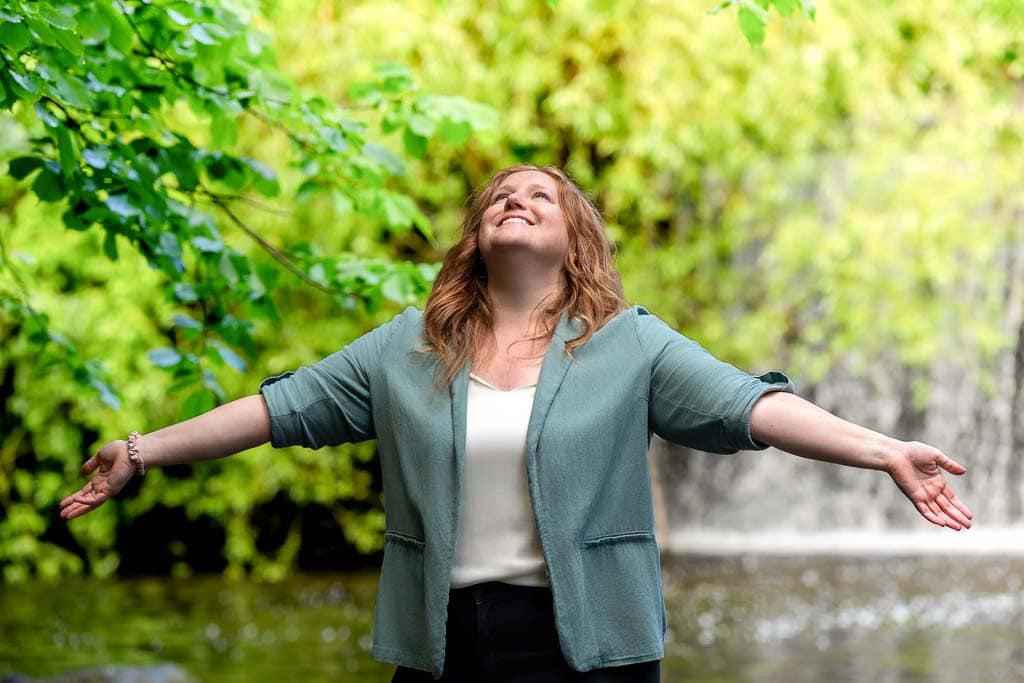
Genuine laughter provided the warmth and playfulness needed to balance the more direct portraits in Jordan’s brand photography collection.
Giving plenty of direction without creating stiff photographs
Jordan told me before the shoot that she didn’t feel comfortable about the idea of having her photograph taken. Most of my clients don't, actually.
She was concerned that her smile could look false, that tiredness might show around her eyes, and that she’d slouch if left to arrange herself. She specifically asked me to give her plenty of guidance and assured me that she wouldn’t be offended by direct instructions.
That's the way I work anyway.
Looking natural in a photograph doesn’t usually mean receiving no direction. Most people aren’t aware of what their hands are doing, how they’re distributing their weight or whether the position that feels relaxed actually looks like they’ve temporarily become a sack of potatoes. I mean, why would they?
I gave Jordan continuous guidance about posture, movement, hands, expression, and where to direct her attention. Once those practical decisions had been taken away from her, she didn’t have to monitor herself or wonder whether she was doing the right thing, because she knew I had it all in hand.
That left room for the genuine expressions.
The resulting photographs don’t look heavily directed, but that doesn’t mean no direction was involved. It means the direction did its job without becoming the subject of the photographs.
I’ve written more about how to feel confident during a photoshoot because confidence doesn’t have to exist before the camera comes out. It can develop during the session when you know you’re not being left to work everything out alone.
Using colour, movement, and expression to create variety
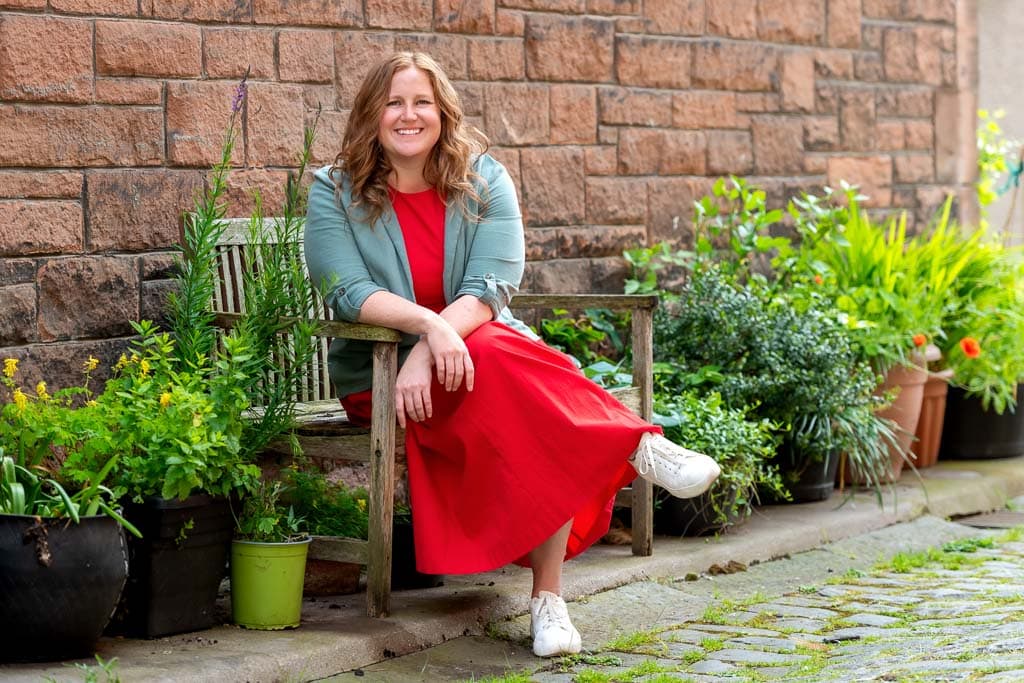
Jordan brought several outfits, including a moss-green blazer, a patterned velvet jacket, and a red midi dress.
The clothing needed to feel recognisably hers while also working with Edinburgh’s stone, foliage, and painted doors. We avoided relying too heavily on cream or pale neutrals, which could’ve disappeared against some of the city’s architecture.
The green blazer created a connection with Jordan’s love of nature and worked beautifully against both stone and foliage. The red dress gave us something bolder and introduced a different energy later in the shoot.
We also varied how Jordan occupied the frame. Some photographs use direct eye contact and feel steady and reassuring. Others show her walking, laughing, looking away or engaging with the landscape.
That variety makes the collection particularly useful for her. A direct portrait might suit a page discussing complex trauma. A laughing photograph could work with something more personal. A walking image could accompany an article about change, while the Brainspotting photographs can illustrate a specific therapeutic method.
The aim wasn’t to create variety for its own sake but rather it was to make sure Jordan wouldn’t have to use the same smiling portrait everywhere regardless of what she was trying to communicate.

The red dress and blue doorway created a bolder image for content where Jordan wanted her confidence and individuality to come across immediately.

Walking photographs introduced movement while Dean Village provided colour, texture, and a recognisable sense of Edinburgh.
Choosing locations, clothes and activities becomes much easier once you’ve established what the photographs need to communicate. Which is exactly why my approach to planning a brand photoshoot begins with the business and its audience rather than a list of attractive places to stand.
A collection that felt like Jordan
The finished collection included direct portraits, more reflective photographs, genuine laughter, movement, working details, and images showing Jordan’s relationship with the outdoors.
Each image had a different potential role, from introducing her on her About page to explaining Brainspotting or accompanying content about healing, curiosity, and change.
The most important test, though, was whether Jordan recognised herself in the photographs. In her Google review, she wrote:
“After reaching out, it was clear that she genuinely wanted to understand my business, my personality, and how I wanted to portray myself. That care and intentionality was the through-line during the entire process. Before and during the shoot, Donna made sure we were capturing not just what I do, but who I am.”
That distinction is particularly important for therapists and other service-based professionals. Prospective clients aren’t only choosing a particular method or qualification. They’re choosing the person with whom they’ll have the conversation.

The finished collection balanced Jordan’s professional expertise with the warmth, humour, and humanity she wanted prospective clients to recognise.
Why Jordan is worth knowing
Jordan’s approach may be particularly relevant if conventional talk therapy has helped you understand your experiences intellectually, but hasn’t changed how your mind and body respond to them. She works with trauma, chronic pain, anxiety, relationship difficulties, and patterns that people find themselves repeatedly returning to.
Rather than relying on conversation alone, Jordan combines Brainspotting, IFS-informed parts work, Reiki, and an understanding of the relationship between the brain, body, and nervous system. I found her approach fascinating, partly because it was unlike anything I’d encountered before, but also because she explains complicated ideas in such a direct and human way.
Jordan offers online therapy to clients throughout Colorado. She also works with coaching clients throughout the United States and internationally, so you don’t need to live in Colorado – or even in the US – to work with her. Coaching isn’t therapy or mental health treatment, but Jordan draws on many of the same brain-body, nervous-system, and parts-based perspectives that inform her therapeutic work.
You can learn more about her approach, read about the different ways of working with her, and book a free introductory consultation through the Lion Heart Coaching & Counseling website.
Are you looking for therapist brand photography in Edinburgh or elsewhere in Scotland?
Therapists often need photographs to communicate things that can’t be demonstrated with a product or conventional working process. Your prospective clients may need to see warmth, strength, humour, directness or an unusual approach before they feel ready to find out more.
Those distinctions can be built into the locations, clothing, expressions, activities and details we photograph.
I work with therapists, consultants, coaches and other independent professionals in Edinburgh to create image libraries that help prospective clients understand both the work and the person behind it.
For most business owners who need a substantial collection to use across their website and ongoing marketing, I recommend my Soar brand photography package. The longer session gives us room to photograph different locations, outfits, activities and aspects of your personality without trying to cram everything into an hour.
If you only need a smaller, more focused update, Elevate offers the same careful planning and guidance within a shorter session.
If you need more than a pleasant collection of portraits, please get in touch and tell me what you want people to understand about you and your business. That’s where we’ll begin.